AI vs. Manual Photoshop Retouching: Which One Does Your E-Commerce Brand Need?
E-commerce is more visual than ever. Whether you sell fashion, jewelry, furniture, cosmetics, electronics, or lifestyle products, your product images can have a major impact on how customers perceive your brand.
But creating professional e-commerce images raises an important question:
Should you use AI photo editing, traditional manual Photoshop retouching, or a combination of both?
The answer depends on your product, image volume, quality requirements, and brand goals.
In 2026, AI image editing has become extremely useful for repetitive tasks such as background removal, basic cleanup, image enhancement, and batch processing. At the same time, professional Photoshop retouching remains valuable when an image requires precise control over product details, edges, colors, textures, shadows, and proportions.
For many e-commerce brands, the best approach isn't AI vs. Photoshop.
It is AI + expert manual retouching.
What Is AI Photo Retouching?
AI photo retouching uses artificial intelligence to automatically analyze and modify an image.
Modern AI-powered editing tools can perform tasks such as:
- Background removal
- Background replacement
- Object removal
- Dust and minor blemish cleanup
- Basic color correction
- Image enhancement
- Simple lighting adjustments
- Canvas expansion
- Batch image processing
- Basic product image optimization
For brands with hundreds or thousands of product images, these automated processes can significantly reduce editing time.
AI is particularly useful when the required editing is repetitive and predictable.
For example, if you have 1,000 product images that all need a clean white background and similar basic adjustments, AI can help process the initial workload quickly.
What Is Manual Photoshop Retouching?
Manual Photoshop retouching involves an experienced image editor working directly on the image using professional editing techniques.
Instead of relying entirely on automated decisions, the editor can inspect the product at pixel level and make precise adjustments.
Manual Photoshop editing is especially useful for:
- Jewelry retouching
- Fashion photography
- Apparel and clothing images
- Complex product retouching
- Furniture photography
- Beauty and cosmetic products
- High-end advertising images
- Ghost mannequin editing
- Detailed shadow creation
- Precise color correction
- Complex masking
- Removing difficult objects
- Correcting product imperfections
Manual retouching is particularly important when product accuracy matters more than simply making an image look attractive.
For e-commerce, this distinction is important.
Customers expect the product shown in the photograph to represent the actual product they receive.
AI vs. Manual Photoshop: A Quick Comparison
| Feature | AI Retouching | Manual Photoshop |
|---|---|---|
| Speed | Excellent | Moderate |
| Bulk processing | Excellent | Good |
| Background removal | Excellent for simple images | Excellent |
| Complex masking | Can struggle | Excellent |
| Product accuracy | Depends on the tool | Excellent |
| Fine details | Variable | Excellent |
| Color precision | Good | Excellent |
| Jewelry retouching | Good for simple cleanup | Excellent |
| Fashion retouching | Good | Excellent |
| Creative manipulation | Good | Excellent |
| Consistency | Excellent with controlled workflows | Excellent with professional standards |
| Human judgment | Limited | Excellent |
| Best for | High-volume routine editing | Detailed professional editing |
When Should Your E-Commerce Brand Use AI?
AI can be an excellent choice when you need speed and scalability.
1. You Have a Large Product Catalog
If your store has hundreds or thousands of product images, manually editing every image can take a significant amount of time.
AI can help automate repetitive processes and make high-volume image production more efficient.
2. Your Images Need Simple Background Removal
If your products are photographed clearly against relatively simple backgrounds, AI background removal can be very effective.
This is useful for online stores that need clean product images for marketplaces, websites, catalogs, and advertising.
3. You Need Fast Turnaround
AI-powered workflows can process routine edits much faster than traditional one-image-at-a-time editing.
That makes AI particularly useful when you are launching a new collection or uploading a large number of SKUs.
4. Your Editing Requirements Are Repetitive
AI works best when the same type of edit needs to be performed repeatedly.
For example:
Remove background → clean image → resize → export.
This type of workflow can be highly automated.
When Does Manual Photoshop Retouching Make More Sense?
AI isn't the perfect solution for every product image.
Some images require a human editor who understands the actual product and can make decisions that automated software may not handle correctly.
1. Jewelry Images
Jewelry contains extremely fine details.
Diamonds, gemstones, metal surfaces, reflections, chains, prongs, and tiny edges can require careful editing.
An automated tool may produce an attractive result while unintentionally changing the appearance of the actual product.
For premium jewelry brands, maintaining authenticity is critical.
2. Clothing and Fashion Images
Apparel photography often requires more than simply removing a background.
Professional retouching may involve:
- Removing wrinkles
- Improving fabric appearance
- Correcting folds
- Fixing stitching issues
- Adjusting garment proportions
- Creating realistic shadows
- Ghost mannequin editing
- Correcting colors
- Cleaning the fabric
- Maintaining texture
These edits require careful judgment.
3. Complex Product Images
Products with complicated edges, transparent materials, reflections, glass, hair, fur, or intricate structures can require advanced masking and manual Photoshop techniques.
4. Premium Advertising Images
Your hero image is often one of the most important images on your product page.
If the image will appear in:
- Website banners
- Amazon listings
- Shopify stores
- Social media advertising
- Printed catalogs
- Digital advertising campaigns
then precision becomes more important.
The Biggest Problem With Using AI Alone
AI can make an image look better, but better-looking does not always mean more accurate.
For e-commerce, accuracy is essential.
An AI system may sometimes alter:
- Product shape
- Fine texture
- Labels
- Logos
- Small details
- Reflections
- Fabric patterns
- Jewelry details
- Product proportions
Modern AI retouching systems have improved significantly, but image quality still needs to be checked against the original product reference. Current retouching guidance emphasizes checking geometry, text, color, texture, reflections, shadows, scale, and other product-specific details before publishing.
That is why professional quality control remains important.
Why AI + Photoshop Is Often the Best E-Commerce Workflow
Instead of choosing one technology, many brands can benefit from combining both.
Think of it this way:
AI = Speed
Photoshop = Precision
Human Quality Control = Accuracy
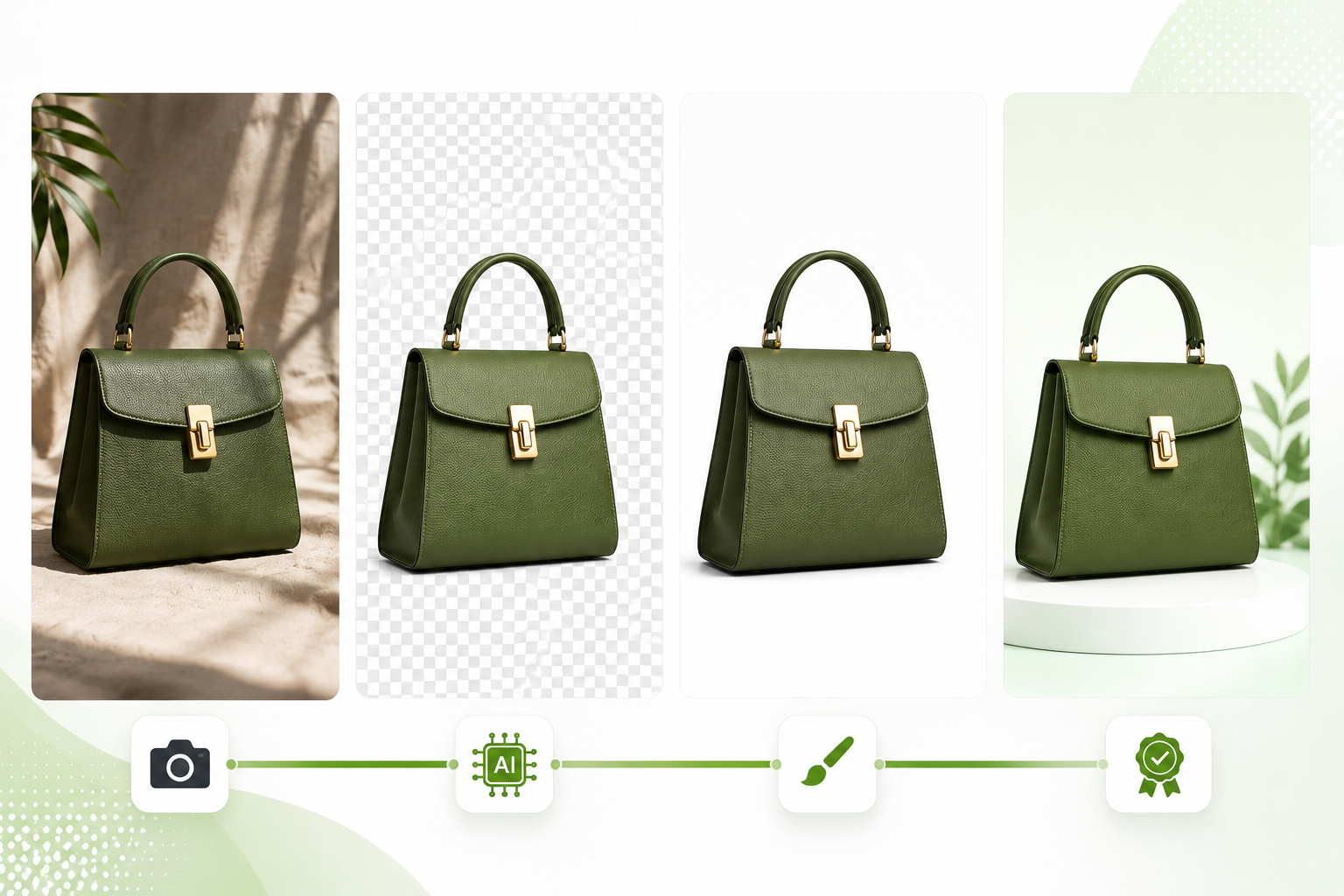
A hybrid workflow can use AI for repetitive tasks while experienced Photoshop editors handle the areas where precision matters.
For example:
Step 1: AI-Assisted Processing
AI can help with:
- Background removal
- Initial cleanup
- Basic enhancement
- Simple corrections
- Batch processing
Step 2: Expert Photoshop Retouching
A professional editor then checks and improves:
- Product edges
- Color accuracy
- Fine details
- Shadows
- Reflections
- Wrinkles
- Texture
- Shape
- Proportions
- Brand-specific requirements
Step 3: Quality Control
Every final image should be reviewed before delivery.
This human review can catch problems that automated editing may miss.
This type of hybrid approach combines the efficiency of automation with the control of professional retouching. Current e-commerce workflows increasingly use automation for repetitive work while reserving human judgment for quality control and brand decisions.
Which Method Is Best for Different E-Commerce Products?
Fashion & Apparel
Recommended: AI + Manual Photoshop
AI can help with repetitive cleanup, while Photoshop is better for wrinkles, fabric details, proportions, color accuracy, and complex garment editing.
Jewelry
Recommended: Manual Photoshop + AI assistance
Fine details, reflections, gemstones, and metal surfaces require careful control.
Furniture
Recommended: AI + Manual Photoshop
AI can speed up background removal and basic cleanup, while manual editing can improve edges, shadows, perspective, and product presentation.
Cosmetics
Recommended: AI + Manual Photoshop
AI can handle routine cleanup, while Photoshop is useful for packaging details, labels, reflections, texture, and color accuracy.
Large Product Catalogs
Recommended: AI-assisted workflow + Human Quality Control
The combination provides speed without completely sacrificing quality.
AI Is Not Replacing Professional Retouching — It Is Changing the Workflow
The biggest mistake is thinking that the choice is simply:
AI OR Photoshop.
The future of professional e-commerce image editing is increasingly about using the right tool for the right task.
AI is excellent at repetitive operations.
Photoshop is excellent at detailed control.
Professional editors are excellent at understanding visual quality, brand requirements, and product accuracy.
Together, they create a much stronger workflow.
Why Image Quality Matters for E-Commerce
Your product image is often the first thing a potential customer notices.
A poorly edited image can make a product look:
- Cheap
- Inaccurate
- Unprofessional
- Inconsistent
- Untrustworthy
A professionally edited image can create a cleaner and more consistent shopping experience.
This is especially important when customers cannot physically touch or inspect the product before purchasing.
High-quality product images help communicate details that customers need when making purchasing decisions.
How to Choose the Right E-Commerce Image Editing Service
Before choosing an editing provider, ask these questions:
Can they handle both AI and manual editing?
A hybrid workflow can give you greater flexibility for different types of images.
Do they understand your product?
Jewelry, fashion, furniture, cosmetics, and electronics all require different editing techniques.
Do they provide quality control?
Automated processing should not mean automated delivery without inspection.
Can they maintain consistency?
Your entire product catalog should have a consistent visual style.
Can they handle bulk orders?
Your editing partner should be able to scale as your product catalog grows.
Can they follow your specific instructions?
Professional e-commerce editing is not simply about making an image beautiful. It is about making the image match your brand and product requirements.
AI + Manual Photoshop Retouching at Clipping Path America
At Clipping Path America, we combine AI-assisted workflows with professional Photoshop expertise to create high-quality images for e-commerce brands.
Our approach is designed around a simple principle:
AI for efficiency. Human expertise for precision.
Our image editing services include:
- Product photo retouching
- E-commerce image editing
- Jewelry image retouching
- Apparel and clothing photo editing
- Fashion photo retouching
- Furniture image editing
- Background removal
- Clipping path
- Color correction
- Shadow creation
- Image manipulation
- Professional portrait retouching
Every project can be handled according to the specific requirements of your brand and product catalog. Clipping Path America currently describes its workflow as AI-assisted with expert Photoshop review and offers scalable image editing for e-commerce and other industries.
Final Verdict: AI or Manual Photoshop?
There is no single answer for every e-commerce business.
If you need speed, automation, and high-volume processing, AI can be extremely useful.
If you need precision, detailed retouching, product accuracy, and creative control, manual Photoshop remains extremely valuable.
But for many professional e-commerce brands, the strongest solution is:
AI + Manual Photoshop + Human Quality Control
This gives your business the speed of modern technology without sacrificing the precision and visual judgment of an experienced professional.
Your customers don't care whether an image was edited by AI or Photoshop.
They care whether the product looks accurate, professional, trustworthy, and worth buying.
That is what your image editing workflow should deliver.
Need Professional E-Commerce Image Editing?
Whether you need 20 product images or thousands of images for a growing catalog, Clipping Path America can help you create consistent, professional product visuals using a combination of AI-assisted technology and expert Photoshop retouching.
Get a Free Quote today and see how professional image editing can improve your e-commerce product presentation.
Clipping Path America — AI-Assisted. Human-Perfected.