# Jewelry Retouching Services: Professional Editing for E-Commerce (2026)
Jewelry photography is uniquely challenging. High reflectivity, intricate metalwork, and delicate gemstones mean that even the smallest specs of dust, fingerprints, or uneven lighting stand out in high-resolution product photos.
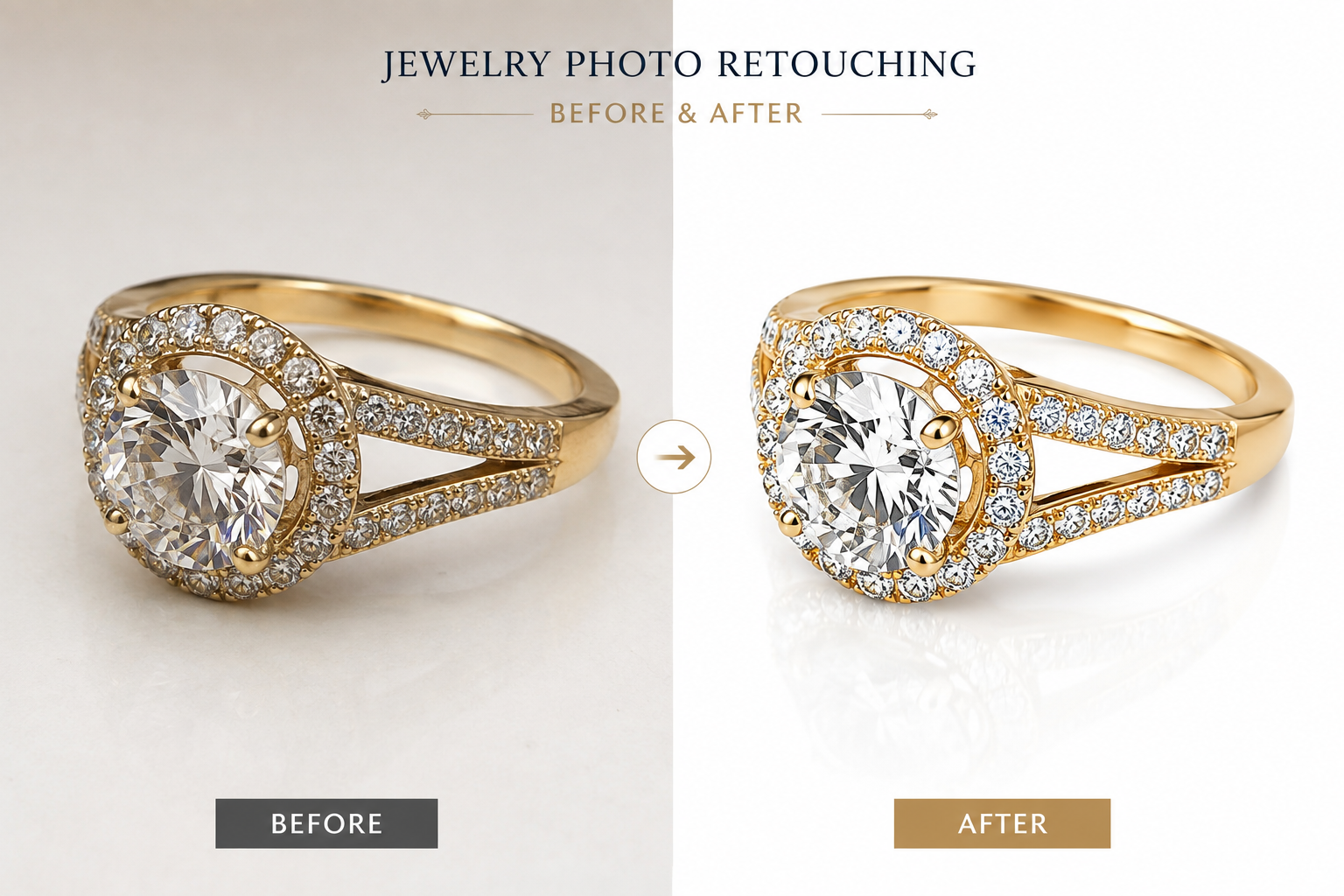
Professional **jewelry retouching** bridges the gap between raw camera shots and polished, studio-quality images that convert shoppers into buyers.
In this guide, you'll learn:
- ✅ Key steps in professional jewelry retouching
- ✅ Tools and techniques used by experts
- ✅ Why e-commerce brands invest in high-quality retouching
- ✅ Common mistakes to avoid
- ✅ How to choose the right retouching service
Let's dive in!
---
## Key Steps in Professional Jewelry Retouching
### 1. Precision Background Removal & Clipping Paths
The foundation of great e-commerce retouching is isolation. Using Photoshop's **Pen Tool**, retouchers manually trace fine details—such as thin chains, intricate prongs, and delicate openings—to separate the piece from its original background.
**Goal:** Place the piece on a pure white (RGB 255, 255, 255) or transparent background required by platforms like Amazon and Shopify.
**Why it matters:**
- ✅ Clean, professional look
- ✅ Platform compliance (Amazon, Shopify, eBay)
- ✅ Consistent catalog appearance
- ✅ Better conversion rates
---
### 2. Surface Cleaning & Imperfection Removal
Macro shots highlight micro-scratches, dust, and handling marks that are invisible to the naked eye but obvious in photos.
**Tools Used:**
- Spot Healing Brush
- Healing Brush
- Clone Stamp Tool
**Best Practice:** Zoom in between 300% to 500% to clean up specs while preserving natural metal textures so the piece doesn't look plastic or fake.
**Common imperfections removed:**
- ✅ Dust and lint
- ✅ Fingerprints and smudges
- ✅ Micro-scratches
- ✅ Manufacturing marks
- ✅ Handling marks
---
### 3. Enhancing Gemstones & Diamonds
Stones often lose their luster under flat camera lighting. Professional retouching brings back the sparkle, fire, and brilliance that makes jewelry irresistible.
**Techniques:**
- Boost contrast and brightness on stone facets using adjustment layers
- Apply selective dodging and burning to enhance sparkle, fire, and depth
- Avoid over-saturating (keeps it natural)
- Enhance clarity without losing authenticity
**Result:** Gemstones that look as stunning in photos as they do in person.
---
### 4. Managing Reflections & Metal Tones
Polished gold, silver, and platinum act like mirrors, often catching reflections of the room or camera equipment. Uncontrolled reflections distract from the product and look unprofessional.
**Solutions:**
- Soften harsh reflections using Selective Color and Hue/Saturation layers
- Re-balance tones for consistency
- Ensure correct color balance:
- ✅ Gold should feel warm
- ✅ Silver should be neutral
- ✅ Rose gold should have soft pink tones
**Why it matters:** Accurate metal tones build trust and reduce returns.
---
### 5. Adding Depth with Natural Drop & Reflection Shadows
Floating jewelry looks unnatural and cheap. Adding subtle reflection or drop shadows grounds the product, creating a 3D effect that mimics real studio lighting.
**Types of shadows:**
- **Drop Shadow:** Below the piece (common for e-commerce)
- **Reflection Shadow:** Mirror effect (luxury look)
- **Natural Shadow:** Soft, realistic shadow
**Best Practice:** Keep shadows subtle (20-40% opacity) to avoid overpowering the product.
---
## Why E-Commerce Brands Invest in High-Quality Retouching
### 1. Builds Customer Trust
Detailed, flawless photos reassure buyers about quality and craftsmanship. When customers see crisp, professional images, they trust that the product matches the description.
**Impact:**
- ✅ Higher confidence in purchase
- ✅ Reduced hesitation
- ✅ Better brand perception
---
### 2. Reduces Product Returns
Accurate metal tones and gemstone colors ensure customers get exactly what they see online. Misleading photos lead to disappointed customers and costly returns.
**Statistics:**
- 22% of returns are due to product looking different than photos
- Accurate photos reduce returns by up to 35%
- Saves money on return shipping and restocking
---
### 3. Consistent Brand Aesthetic
Uniform cropping, lighting, and background styles create a cohesive catalog. Consistency makes your store look professional and trustworthy.
**Benefits:**
- ✅ Recognizable brand identity
- ✅ Professional appearance
- ✅ Easier browsing experience
- ✅ Higher perceived value
---
### 4. Increases Conversion Rates
High-quality photos directly impact sales. Studies show that better product images can increase conversions by 30-40%.
**Why:**
- ✅ Customers can see details clearly
- ✅ Builds desire and emotional connection
- ✅ Reduces purchase anxiety
- ✅ Encourages add-to-cart
---
### 5. Platform Compliance
Marketplaces like Amazon, Shopify, and eBay have strict image requirements. Professional retouching ensures your photos meet all guidelines.
**Requirements:**
- ✅ Pure white background (RGB 255, 255, 255)
- ✅ Minimum 1000px resolution
- ✅ Product fills 85% of frame
- ✅ No watermarks or text overlays
---
## Common Jewelry Retouching Mistakes to Avoid
### Mistake 1: Over-Retouching
**Problem:** Metal looks plastic, gemstones look fake
**Solution:**
- ✅ Preserve natural textures
- ✅ Keep retouching subtle
- ✅ Zoom out frequently to check overall look
---
### Mistake 2: Wrong Color Balance
**Problem:** Gold looks yellow, silver looks blue
**Solution:**
- ✅ Use color checker when shooting
- ✅ Adjust white balance accurately
- ✅ Match actual product colors
---
### Mistake 3: Harsh Shadows
**Problem:** Shadows overpower the product
**Solution:**
- ✅ Keep shadows subtle (20-40% opacity)
- ✅ Match lighting direction
- ✅ Use soft, natural shadows
---
### Mistake 4: Inconsistent Style
**Problem:** Different photos look like different products
**Solution:**
- ✅ Use same editing style across catalog
- ✅ Create style guide
- ✅ Batch edit with same settings
---
### Mistake 5: Ignoring Details
**Problem:** Missed dust, scratches, or imperfections
**Solution:**
- ✅ Zoom in to 300-500%
- ✅ Check every angle
- ✅ Use multiple reviewers
---
## How to Choose the Right Jewelry Retouching Service
### 1. Check Portfolio
Look for before/after examples of similar jewelry pieces. Quality should be consistent across different types of jewelry.
**What to look for:**
- ✅ Clean background removal
- ✅ Natural metal textures
- ✅ Sparkling gemstones
- ✅ Consistent color accuracy
---
### 2. Turnaround Time
Fast delivery is crucial for e-commerce. Look for services that offer 24-48 hour turnaround without sacrificing quality.
**Questions to ask:**
- ✅ What's your standard turnaround?
- ✅ Do you offer rush delivery?
- ✅ Can you handle bulk orders?
---
### 3. Pricing
Transparent pricing with no hidden fees. Compare per-image rates and bulk discounts.
**Typical pricing:**
- ✅ Basic retouching: $3-5/image
- ✅ Advanced retouching: $5-10/image
- ✅ Bulk discounts: 20-40% off
---
### 4. Free Sample Edit
Reputable services offer free sample edits so you can evaluate quality before committing.
**Always request:**
- ✅ Free sample (1-2 images)
- ✅ Same-day delivery
- ✅ No obligations
---
### 5. Customer Support
Responsive support for revisions, questions, and special requests.
**Look for:**
- ✅ 24/7 support availability
- ✅ Quick response time
- ✅ Unlimited revisions policy
---
## FAQ
### Q1: How long does jewelry retouching take?
**A:** Depends on complexity:
- **Basic retouching:** 15-30 minutes per image
- **Advanced retouching:** 30-60 minutes per image
- **Bulk orders:** 24-48 hour turnaround
**Professional services** typically deliver within 24 hours for standard orders.
---
### Q2: What file formats do you accept?
**A:** Most services accept:
- ✅ RAW (CR2, NEF, ARW)
- ✅ JPEG
- ✅ PNG
- ✅ TIFF
**Best:** Shoot in RAW for maximum editing flexibility.
---
### Q3: Can you match specific color requirements?
**A:** Yes! Professional retouchers can:
- ✅ Match Pantone colors
- ✅ Match physical samples
- ✅ Ensure platform compliance (Amazon white background)
- ✅ Maintain brand color consistency
---
### Q4: Do you offer bulk discounts?
**A:** Most services offer:
- ✅ 10-50 images: 10-20% discount
- ✅ 50-200 images: 20-30% discount
- ✅ 200+ images: 30-40% discount
**Tip:** Ask about volume pricing before ordering.
---
### Q5: What if I'm not satisfied with the results?
**A:** Reputable services offer:
- ✅ Free revisions
- ✅ Unlimited edits until satisfied
- ✅ Money-back guarantee (some services)
- ✅ Free sample before bulk order
**Always confirm revision policy before ordering.**
---
## Conclusion
Professional jewelry retouching is essential for e-commerce success. High-quality images:
- ✅ Build customer trust
- ✅ Reduce product returns
- ✅ Increase conversion rates
- ✅ Ensure platform compliance
- ✅ Create consistent brand aesthetic
**Key Steps:**
1. ✅ Precision background removal
2. ✅ Surface cleaning & imperfection removal
3. ✅ Enhancing gemstones & diamonds
4. ✅ Managing reflections & metal tones
5. ✅ Adding natural shadows
**Need Professional Jewelry Retouching?**
**ClippingPath America offers:**
- ✅ Professional Jewelry Retouching
- ✅ Background Removal & Clipping Paths
- ✅ Gemstone Enhancement
- ✅ Color Correction & Metal Tone Balancing
- ✅ 24-Hour Delivery
- ✅ FREE Sample Edit!
---
## Related Articles:
- [How to Edit Product Photos for Amazon & Shopify](how-to-edit-product-photos-amazon-shopify)
- [How to Remove Background from Photo](how-to-remove-background-from-photo)
- [Best Background Remover Tools Online](best-background-remover-tools)